
Two games into the Ryan Silverfield era, the Arkansas Razorbacks’ offense looks nothing like the adaptable, efficient unit promised during the offseason. After a sluggish 31-14 win over North Alabama and a lifeless 43-10 defeat at No. 20 Utah, the Hogs sit near the bottom of the FBS in rushing efficiency and have yet to establish any reliable way to move the ball consistently. Offensive coordinator Tim Cramsey summed up the situation bluntly this week: “It’s time to coach.”
The Numbers Don’t Lie
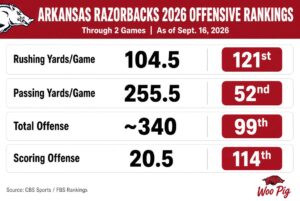
Through two games, Arkansas is averaging just 104.5 rushing yards per game (tied for 121st nationally) and a dismal 2.7 yards per carry — the worst mark among Power 4 teams. Against Utah the run game completely collapsed: 61 yards on 28 attempts (2.2 yards per carry). Starting backs Sutton Smith and Braylen Russell combined for modest production, and KJ Jackson finished as the team’s leading rusher with 34 yards.
The passing game has been only marginally better. Jackson completed 24 of 35 passes for 267 yards and three touchdowns against North Alabama. In Salt Lake City he regressed sharply, going 14 of 34 for 139 yards, no touchdowns and an interception. For the season he sits at 38 of 69 (55.1 percent) for 406 yards, three touchdowns and two interceptions.
Scheme vs. Execution
Cramsey’s scheme is designed to be flexible. It is built primarily around 11 personnel but freely shifts into other groupings without substitutions. The attack draws from West Coast timing concepts, heavy pre-snap motion, and an outside-zone heavy run game. Cramsey has repeatedly said the system should adapt to the quarterback rather than force the player into a rigid mold.
In theory that should suit Jackson, a dual-threat who showed poise in limited action last season. In practice, the offense has produced almost no explosive plays and has left receivers without a clear hierarchy of go-to targets. Chris Marshall led the team in receiving against North Alabama, but the group as a whole has lacked a consistent chain-mover or vertical threat when defenses tighten.
The Offensive Line Bottleneck
The offensive line has been a major contributor to the stagnation. It has struggled to create consistent push in the run game and has left Jackson under pressure more often than the staff would like. When the Hogs cannot run effectively, defenses can sit in man coverage or bring pressure knowing Arkansas has shown little ability to beat it consistently down the field.
Silverfield pointed to exactly that cycle after the Utah loss: if the Hogs cannot throw against man coverage, opponents will keep loading the box and the run game will stay dead.
What’s Next?
Silverfield has publicly backed Jackson as the starter for Saturday’s home game against No. 2 Georgia. Cramsey has emphasized making Jackson more comfortable — possibly by incorporating more designed runs or quicker throws — while accepting responsibility for the unit’s performance.
The calendar offers little mercy. Georgia arrives in Fayetteville with one of the nation’s most talented defenses. A continued inability to run the ball or sustain drives would make the game a long afternoon and raise sharper questions about whether the scheme, the personnel, or both need faster adjustments.
The offense does not need to become elite overnight. It simply needs an identity — a reliable way to gain four yards when it needs three, a receiver who can be counted on in third-and-medium, and a quarterback who can operate the system with consistent accuracy. Until those pieces appear, the Silverfield-Cramsey era will continue to look like a work in progress that is progressing far too slowly.
Leave a Reply